
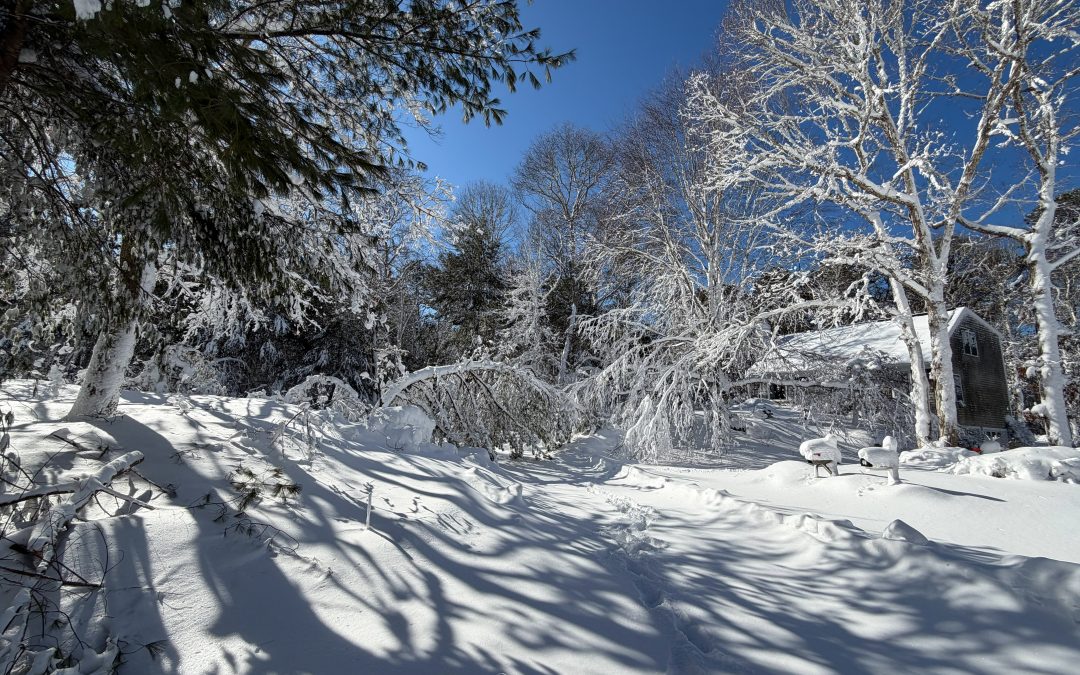

On Sunday, January 25, a path is cleared in a residential area after the heavy snowfall.
In Scott Corbett’s 1953 memoir, “We Choose Cape Cod,” the author boldly asserts to a friend who questions his choice of the cold Northeast that Cape Cod is immune to snowy winters that blanket the rest of New England under feet of powder. Early in the book the snow indeed begins to fall atop his new home and, confident that what will come down, won’t at first believe that a true storm is upon him until he wakes the following morning to a foot of snow on the ground.
This is hardly the first or last piece of recollection that struggles to conceive of the Cape as a snowy place and, though the sea does warm us in the winter to a point where rain will fall when the rest of the region breaks out the shovels, snow does fall in prodigious quantities. Along with the snow come the wind and waves of the classic nor’easter (nor’easter is the common, but incorrect, vernacular). Last winter was a stark reminder that snow falls and the wind blows across the Cape in the cold months. Winter storms are at once idyllic and treacherous. They blanket the region with a beautiful backdrop and lay a hush across the region at the same time they wreck ships and close down the town. The variety of opinions on the snow is as varied as the outcomes of the storms, but there is no denying that the Cape has seen some truly wild winter weather.
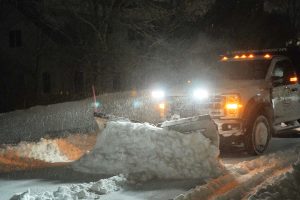
A plow truck makes its way through a residential area Sunday evening following the heavy snowfall.
At the close of the 19th century, the Cape’s population stood at around 30,000, spread thinly between the towns of Bourne and Provincetown. By this time the railroad had spread to its furthest reaches of the Cape; along the tracks were telegraph and telephone wires, all working in concert to connect the Cape. The old salts who plied the seas still relied on the accumulated weather wisdom of the generations who had come before them, but increasingly the advent of speedy communications was allowing weather prediction to take a scientific approach. Storms roaring up the coast could be charted and tracked, and behavior patterns analyzed. The optimism surrounding the spirit of innovation and progress had not yet dimmed with the start of World War I. There was still an unconquerable feeling. Into the still gloaming of a late November night roared the storm soon to be dubbed the Portland Gale for the steamer lost at sea that night. Snow fell along with rain, and the wind howled.
As the 20th century progressed, weather predictions became more accurate, relying less on physical observations of those in the storm’s path and more on technologies like satellites and radar. This did not mean that great snowfalls and fierce winds would not do their damage to the Cape. Snowy winters still brought life to a standstill and created perils at sea and on land. In 1952, a fierce gale blew through New England, wrecking the ships Pendleton and Fort Mercer and catapulting a small motor lifeboat and her crew into the lore of the US Coast Guard. Though only four inches of snow fell it was wet and heavy, which, along with the wind, took down power lines. Three days later, six more inches fell and on February 27, 20 inches of snow, along with more wind, fell on the Cape, bringing life to a standstill.
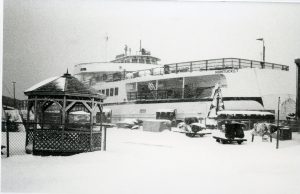 The Blizzard of 1978 crippled the state but spared the Cape the worst of the snow, though only relative to the complete standstill further inland. The sea played a large part in this storm where the Cape was concerned.
Thanksgiving 1989 saw a foot of snow, postponing the Cape’s annual Thanksgiving football games. Students joined municipal employees in clearing the field of play.
The Nor’easter of 2005 dumped 32 inches of snow on Falmouth and nearly three feet on parts of Yarmouth. Schools closed their doors for a week.
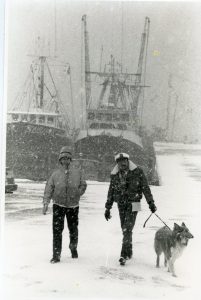 The Blizzard of 2026, fresh in our memories, not only buried the landscape in heavy, wet snow, but also knocked out power to much of the Cape, in some instances for days.
Other storms have visited the Cape with varying intensity and will continue to traverse the region. The five storms mentioned here are only a small sampling of the many memorable and forgotten snowfalls through the years, but no doubt new memories will be made.