
By BARBARA CLARK
Enterprise File Photograph
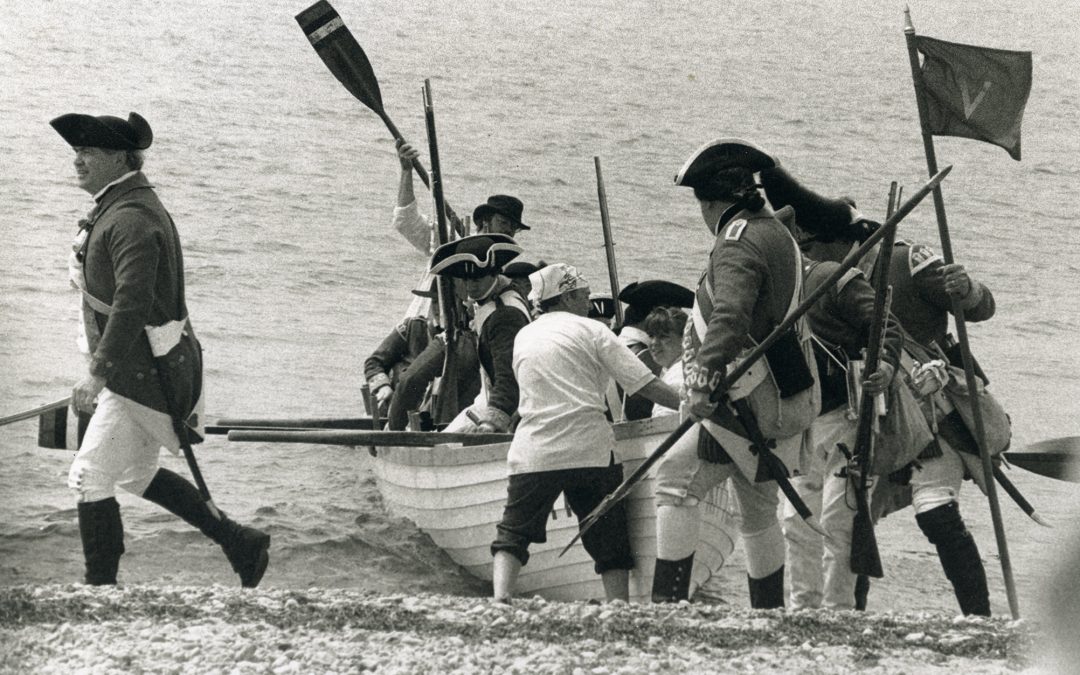
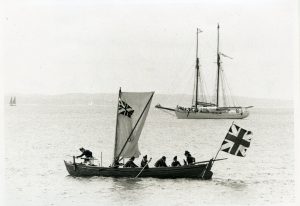
HMS Pernicious rows past the sloop Providence during the reenactment of the Battle of Falmouth, June 11, 1999.
Cape Cod may not be the first area that comes to mind if you’re thinking about the 250th anniversary of the Declaration of Independence. We tend to think first of Paul Revere, Bunker Hill or the Lexington Green. But don’t be so quick to pass Cape Cod by. During the time of the Revolution, the Cape’s ocean gateway offered opportunities for plenty of action, including several noteworthy local events that directly impacted the course of the war. Not to mention the thousands of Cape Codders who fought and the many who lost their lives during the conflict, seen in the many grave markers at more than 60 burial grounds across the Cape.
The Battle of Falmouth
Take a look at a map of Massachusetts and note the waterways, coves and inlets that surround the southern portion of Cape Cod, including a succession of small islands that dot the approach to shore, and its accessible harbors. The Falmouth area looks like a perfect place for the Redcoats to land a troop vessel and replenish provisions. In fact, local historian David Martin said that by 1779, well into the war, British troops were “regularly raiding the coast for supplies.” Martin, chairman of the historians committee that created the 2025 book “The Revolutionary War on Cape Cod and the Islands,” wrote that by that spring the British, so far from home, were in desperate need of food and provisions for their troops. The southern Massachusetts coast offered enticing landfall prospects and an “availability of easily accessible farms” as a supply line for provisions.
A chapter in the book tells the story of a battle that landed ashore on Cape Cod, claiming a place in the engrossing history of this revolutionary time. Falmouth’s location, said Martin, made it “a good choice” for an attempted landing, and the Battle of Falmouth became the only hands-on engagement that touched down on Cape Cod soil during the Revolutionary War.
The British were tired of interference, counter raids and pushback from Cape Codders who objected to having their farms and homesteads raided for supplies. British military command decided that once and for all they would just burn Falmouth to the ground and be done with it, and decided to implement their plan on April 3, 1779.
An exciting story in Cape Cod history is just how that plan was foiled. The night before the planned torching, John Slocum, a tavern owner on the island of Pasque and, incidentally, a Loyalist, overheard the invasion plans as he entertained British troops at his tavern. Though he was a Tory, the plan to destroy Falmouth tipped his loyalty scale, and he realized that the Falmouth folks needed to be warned immediately. Slocum enlisted his young son, then about 10 years old, to row alone for several miles across the dark ocean of Vineyard Sound to alert officials in Woods Hole of the impending attack. The rowing feat was perhaps slightly illuminated by a moon two days past full. Think of it as a kind of mini Paul Revere ride, this time over the water.
The Woods Hole militia was duly warned in the nick of time (hopefully the young oarsman was rewarded with warm blankets and a cup of something warm). Local Falmouth militiaman and Revolutionary War officer Major Joseph Dimmick sped into action, enlisting the local troops and also sending out a call for reinforcements from neighboring Sandwich and Barnstable. The militiamen set to work overnight, improving the trenches that buffered what is now Surf Drive, to confront the landing attempt.
On the morning of April 3, a landing force of 220 British soldiers rowed in to the Falmouth shore and launched incendiary bombs intended to set off destructive fires, but the invasion was repulsed by more than 200 militiamen in the trenches along the beach, as well as by lucky wet spring weather that diffused the weapons’ power to ignite properly. The British were forced to retreat to their warships. Attempts to launch the battle at other locations, such as Nobska Point, kept up all day long, but the outraged colonists proved a match for the invaders and the British fleet at last headed away from shore, thus the local farmers and fishermen proved victorious. A painting at Falmouth Town Hall commemorates the battle and its victory.
Barnstable County Courthouse
An earlier frame of history was ignited at the historic Barnstable County Courthouse on Old King’s Highway in Barnstable on Sept. 27, 1774, well before any Revolutionary combat began. The wood-frame, Georgian-style courthouse became the site of a crucial citizens protest that helped free the local courts from British control. The building (now restored and owned by Tales of Cape Cod) is one of only two Massachusetts colonial-era courthouse buildings that still survive, and where such protests erupted. In the Province of Massachusetts, these smaller declarations of independence from British rule were made clear well before the famous Declaration on July 4, 1776.
Enterprise File Photograph
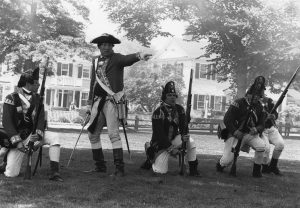
The Redcoats plan their strategy on the Falmouth Village Green during the reenactment in June 1999.
This is how it happened: in late 1773, colonists reacted to the Crown’s imposition of a tax on tea coming into the colonies from Britain by throwing a giant tea party, dumping about 46 tons of good British tea into Boston Harbor in mid-December.
One thing led to another, and the infamous Boston Tea Party brought a response from the Crown in the spring of 1774, when Britain passed several punitive Coercive Acts (known in the colonies as the Intolerable Acts).
Perhaps most onerous to the colonists was the Massachusetts Government Act, which struck down local rules of governance that had been in effect for more than 80 years. This longstanding charter had allowed the colonists to hold town meetings to elect their own local officials and jurists, as well as choose their delegates to the provincial House of Representatives. The new “intolerable” act meant the British governor now made all such jurist appointments, revoking this longstanding independent choice for the colonists.
In response, on a late September day a large group of Massachusetts protesters met in Sandwich and marched for 12 miles along the Old King’s Highway, past the Great Marsh to the county court to protest these new rules of governance. The building housed a courtroom only; juries deliberated in the nearby Crocker Tavern.
At the courthouse they were joined by protesters from the faraway wilds of Chatham and Truro, forming an estimated crowd of 1,500—more than 10 percent of Cape Cod’s residents. The protest and its follow-up meetings with Barnstable County officials closed down the court’s activities.
After all local officials agreed to ignore the British Parliament’s new rules of appointment, this effectively ended Britain’s oversight of the courts on Cape Cod. Similar protest actions were repeated in counties across Massachusetts as jurors declined to take their oaths, declaring independence in judicial matters, and it resonated as surely as did the “shot heard ’round the world” at Lexington and Concord the following year.
The Wreck of the Somerset
On Nov. 1, 1778, the formidable 64-gun British warship HMS Somerset was wrecked in a violent storm off Provincetown and Truro.
Enterprise File Photograph
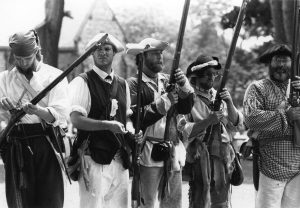
Members of the Colonial Militia get ready for a mock battle on the Falmouth Village Green in June 1999.
The Somerset’s many feats in battle had been well chronicled during the Seven Years’ War (1756-63), as well as in notable service during the early part of the Revolution from 1774 to 1776, including the Battle of Bunker Hill (1775).
In his famous “Midnight Ride of Paul Revere,” Henry Wadsworth Longfellow offered a description of the warship’s powerful aspect:
Just as the moon rose over the bay,
Where swinging wide at her moorings lay
The Somerset, British man-of-war;
A phantom ship, with each mast and spar
Across the moon like a prison bar,
And a huge black hulk, that was magnified
By its own reflection in the tide.
The famous warship, however, met its end as a victim of Cape Cod’s treacherous waters, one of many hundreds of vessels that over the years were wrecked on its sandbars and shoals. In the Cape Cod book on the Revolution, local historian and lecturer Ron Peterson described how on November 1 the vessel “began floundering off the east coast of Cape Cod during a terrific storm. The ship ran aground on the southwest end of the Peaked Hill Bar off Provincetown and Truro.” Several initial boats with survivors failed to make it to land, but Peterson wrote that, “Ultimately, 460 British sailors came ashore and were provided for by Truro’s 250 families.”
Around Friday, November 5, Peterson recounted, “The prisoners began a march to Boston under the guard of Captain (Isaiah) Atkins’ militia (from Truro). Militias from each town along the way picked up the guard as the column made its way across the Cape.” Some prisoners may have “walked off along the way,” he said, but most arrived in Boston on November 12 to eventually be exchanged for patriot prisoners held by the British.
Dennis historians Diane Rochelle and Bob Poskitt, who also contributed a chapter to the book, noted that partial remains of the famous warship still resurface occasionally, most recently in 2010: “To this day, the Somerset lies buried in the sands off Truro,” where nor’easters have occasionally dislodged her remains. “Be careful as you wander the sand hills of Hog’s Back because one day you may trip on her bones.”
The Province Lands Visitors Center has a lookout marker indicating the approximate location of these bones, which surface periodically from under the shifting sands.
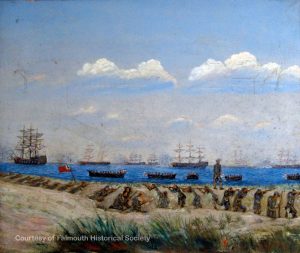
COURTESY FALMOUTH HISTORICAL SOCIETY
Franklin L. Gifford’s depiction of the Battle of Falmouth shows the dug-in local militia facing off against British warships. The stretch of coastline where the majority of the battle was fought is current-day Surf Drive Beach.
Wreck of the William
Speaking of wrecks, it’s not widely known that Cape Cod had a real connection to the 1773 Boston Tea Party, when energized Patriots dumped 340 chests of the tea into Boston Harbor. Less well known is that a fourth ship, the William, had departed England at the same time, carrying another 58 chests in the consignment bound for Boston. The William ran aground off Race Point, just days before the famous Tea Party. Writing about these events, Peterson noted that regarding the vessel’s cargo, not all was lost. “The crew managed to carry all of the cargo ashore in an apparent hope of repairing the ship, but, a few days later, those hopes were dashed when another storm destroyed the vessel.” Of the salvaged chests, 55 remained undamaged.
There followed a lively saga of attempts and often devious plans on what to do with the surviving tea—a controversy that lasted for months. The more-rabid Patriots hustled up with hopes that another, perhaps smaller tea party might ensue, while professional salvage experts as well as local Cape entrepreneurs converged to try and take charge of the chests.
A couple of schooner captains surfaced in a preamble to claiming possession of, storing or selling the goods, but strangely it was hard to find ships willing to transport what they called the “cursed tea.” One such, Captain John Cook with the schooner Eunice out of Salem, agreed to carry the tea to Boston, and 51 chests subsequently made their way to the army barracks at Castle Island, where the wildly unpopular Crown representative and Massachusetts Governor Thomas Hutchinson stowed it away securely. Whatever may have happened to it in the months to come, the captive tea somehow vanished from subsequent historical records.
A few chests remaining on Cape Cod became a source of controversy, a political football for the Patriot cause, a test case for would-be wreck salvagers and possibly “fair game” for those who wished to market it for profit. Homes were raided in search of the now-famous tea, some was sold, some undoubtedly was ingested and some was even publicly burned before the arguments faded away and the lead-up to the war itself took prominence in the public eye.
Curiously, Wellfleet resident and salvage expert John Greenough, who early on was disparaged for profiting from the two chests he salvaged and sold, was elected by those same disparagers in 1777 to the Massachusetts Legislature, where he was later given the responsibility of overseeing the salvaged contents of the Somerset wreck, which ironically occurred near the same spot as the wreck of the William.