
By Cearra O’Hern
COURTESY Wikipedia
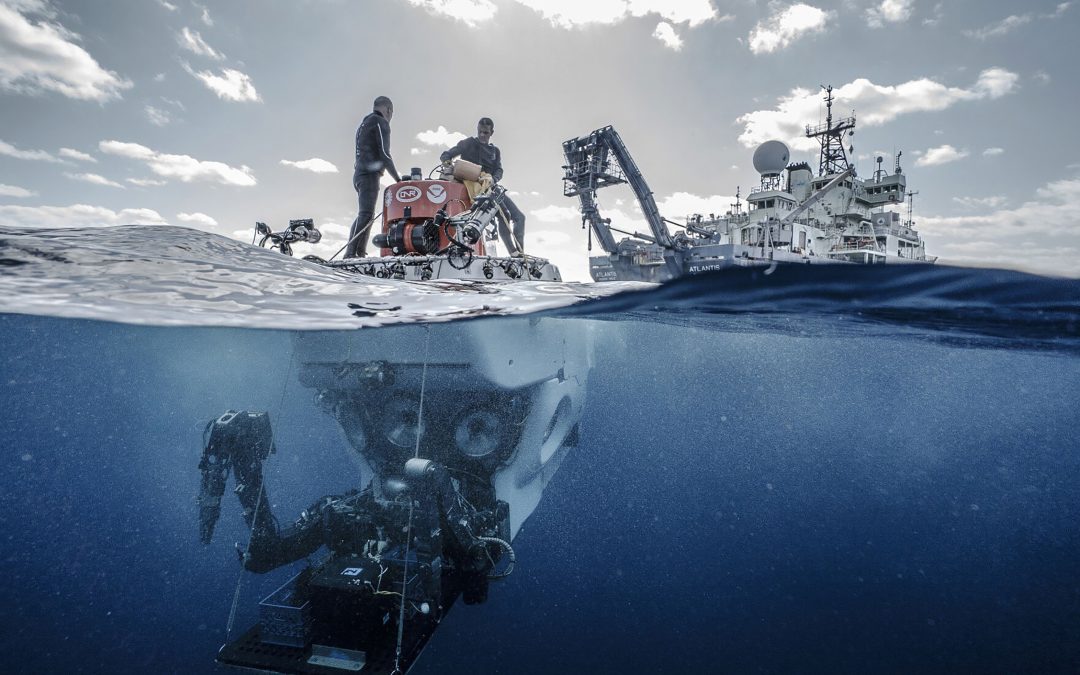
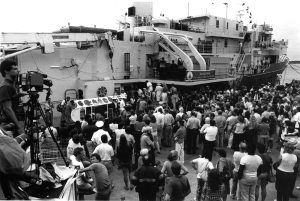
One might know of Alvin, the human-occupied submersible operated by the Woods Hole Oceanographic Institution (WHOI), from its investigations of seafloor hydrothermal systems and their associated ecosystems, which ushered in a new era of ocean exploration and research. One might know of the program from its historic dive to the Titanic in 1986, as it was the first time humans visited the luxury liner since the steamship sank in 1912.
Alvin senior pilot Bruce Strickrott, who has worked with the program for three decades and is currently the most experienced active pilot, first learned about Alvin while flipping through a National Geographic magazine as a child. Alvin’s remarkable discoveries, investigations and continuing contributions to how humans explore ocean waters have inspired Strickrott and countless others to learn about the deep sea for more than six decades.
Alvin is the world’s most recognized deep submersible program, according to an article from WHOI. With its myriad dives, Alvin has provided thousands of researchers with unprecedented access to the deep ocean, allowing extensive observation, data and sample collection. It serves as a transformational building block for ocean engineering and research, supporting groundbreaking scientific studies, enabling development of new tools, fostering early science and engineering careers, and making revolutionary discoveries.
Alvin is funded by the National Science Foundation, the US Navy via its Office of Naval Research and the National Oceanic and Atmospheric Administration. It is the only publicly funded, human-occupied vehicle available to the nation’s scientific community for in-person exploration of the lower abyssal zone and the upper hadal zone, which is one of the least-understood areas of the deep sea and home to hydrothermal vents, submarine volcanoes, subduction trenches and mineral resources, according to an article from WHOI.
Enterprise File Photo
Atlantis II retruns from Titanic.
The idea of Alvin was born around 1956, when WHOI scientist and engineer Allyn Vine suggested building a submersible to study ocean depth. Vine was an early advocate for the nation’s investment in deep-sea exploration, and his suggestion prompted a resolution to develop crewed undersea vehicles.
General Mills was contracted to build a small research vessel in 1962, and soon after the newly formed Woods Hole Oceanographic Institution Deep Submergence Group began using the name Alvin, after Allyn Vine. Alvin was commissioned in June 1964 at a ceremony in Woods Hole.
Alvin’s first major exploration was in response to a request from the Navy in 1966 at the height of the Cold War, according to an article from WHOI. A hydrogen bomb was lost in the Mediterranean Sea after a mid-air collision caused the crash of a nuclear-armed US Air Force bomber, and the successful two-month search proved Alvin’s ability to conduct seafloor operations.
The submersible’s then-steel personnel sphere was replaced with titanium in 1973, extending its diving range to 14,763 feet. The upgrade enabled a joint United States-French expedition the following year, during which scientists viewed a segment of Earth’s mid-ocean ridge in person for the first time in history.
Alvin’s investigations of seafloor hydrothermal systems and their associated ecosystems, in which warm water rises through vertical structures and spews out dissolved chemicals to create environments, changed scientists’ understanding of life on Earth in 1977 and 1979. Discovering new forms of life thriving in environments powered by chemicals in Earth’s crust rather than sunlight revolutionized understanding of where and how life can exist on Earth or elsewhere in the universe.
 “That research has continued since those original discoveries, and over the years more and more has been learned about these sorts of crazy, exotic environments, and how the Earth is not uniquely powered by sunlight,” Strickrott said. “When you discover and understand that, it opens up quite a few possibilities, and that has branched out into the research associated with the ocean worlds of our solar system, particularly places like Europa and some of the moons of Saturn. There is a reasonable chance—and this is just a statement—that there could be similar communities in the oceans of those worlds. That sparks an awful lot of interest and curiosity about the possibility of similar life in our backyard.”
Strickrott said Alvin’s exploration and documentation of the Titanic’s wreck was a “big splash” and brought the program more into the limelight in the late 1980s. In 2010 Alvin participated in a national response to the Deepwater Horizon oil spill, examining deep-sea corals discovered only miles from the wellhead and studying seafloor communities’ response to oil exposure.
Near the end of 2010 and after 4,664 dives, Alvin was taken out of service for a major upgrade. A titanium personnel sphere capable of reaching 21,325 feet was integrated into its modified frame, and the submersible was also equipped with a new command-and-control system to improve lighting and high-definition imaging. Alvin returned to service in 2014 and in 2020 underwent another round of upgrades to build on the earlier improvements.
Alvin was then certified—and recertified in July 2026—to operate at depths to 6,500 meters, reaching more than 99% of the ocean floor, according to an article from WHOI. In recent years Alvin has helped discover pristine coral reefs off the Galapagos Marine Preserve; found five new hydrothermal vents in the eastern tropical Pacific Ocean; and obtained the first close-up images of the wreck of the Quest, the last ship of Antarctic explorer Ernest Shackleton, in the Labrador Sea. The latter expedition returned in July 2026 and was led by the Royal Canadian Geographical Society in partnership with WHOI.
Strickrott, who served as an expedition leader, said exploring the wreck of the Quest was “unusual but quite fascinating” work with Alvin. At the end of July 2026, Alvin left Woods Hole for the Cayman Islands to research other hydrothermal vents. Alvin’s next voyage will be off the East Coast of the United States to study areas where methane is produced and rises from the seafloor, and how animals have adapted to take advantage of such seeps.
Strickrott said Alvin completes a fair amount of work in and around underwater volcanoes as well as larger-scale geological work and microbiology. The submersible conducts almost 100 dives per year to study the processes that create and shape Earth’s crust, the chemical conditions that support life in extreme environments and the vast diversity of life in the deep sea.
Alvin now completes operations with remotely operated vehicles and autonomous underwater vehicles, collaborations that Strickrott said have expanded its capabilities and the amount of data collected. He emphasized that Alvin is constantly improving and changing, and that the current version is the most elegant and technologically advanced.
“It kind of looks like an underwater spaceship,” Strickrott said. “To me, it almost looks like a big mechanical, robotic crab…It is not this old, clunky machine. We have been doing this for a long time, but by no means is [Alvin] old or outdated. This is a state-of-the-art submersible, and it is superbly capable. The work that we do is very impactful, relevant and important, and needs to continue.”
Strickrott added that Alvin is “not just the submersible.”
“We are driven by the people who are asking questions,” Strickrott said. “We are fundamentally supporting the scientists who have done the hard work to get funded and come out with it…I would say, ‘The sky is the limit,’ but that is the wrong metaphor. There is so much open territory on this planet that has never been thoroughly researched, and there is an awful lot out there where we are just figuring things out.”
Strickrott said discoveries can happen at any moment with Alvin, and the opportunities for such discoveries in the ocean are tremendous. He said it is important to remember that much of the open territory on Earth is worth investigating.
Strickrott served in the Navy for six years before returning to school and earning a degree in ocean engineering. To become a pilot of Alvin, he completed a multiyear training program and earned certification as a deep submergence pilot from the Navy.
As an Alvin pilot, Strickrott is responsible for the vehicle, personnel safety, mission execution and helping researchers have “life-changing experiences.” Despite working with Alvin for three decades, Strickrott said, he often has “pinch me moments” and remains in awe of what Alvin is and represents, and that it came from the minds of his inspiring colleagues.
“I am not jaded by this work at all,” Strickrott said. “It is too rewarding.”
Strickrott remains positive about the future of Alvin despite the “tough times” with respect to funding and science. He said the program will need more individuals willing to come to Woods Hole, work with the submersible and go to waters no one has ever seen.
“I would love to go back and just have a beer with the people who conceived [Alvin] and be like, ‘You ought to see what you came up with,”’ Strickrott said.