
By Deborah G. Scanlon
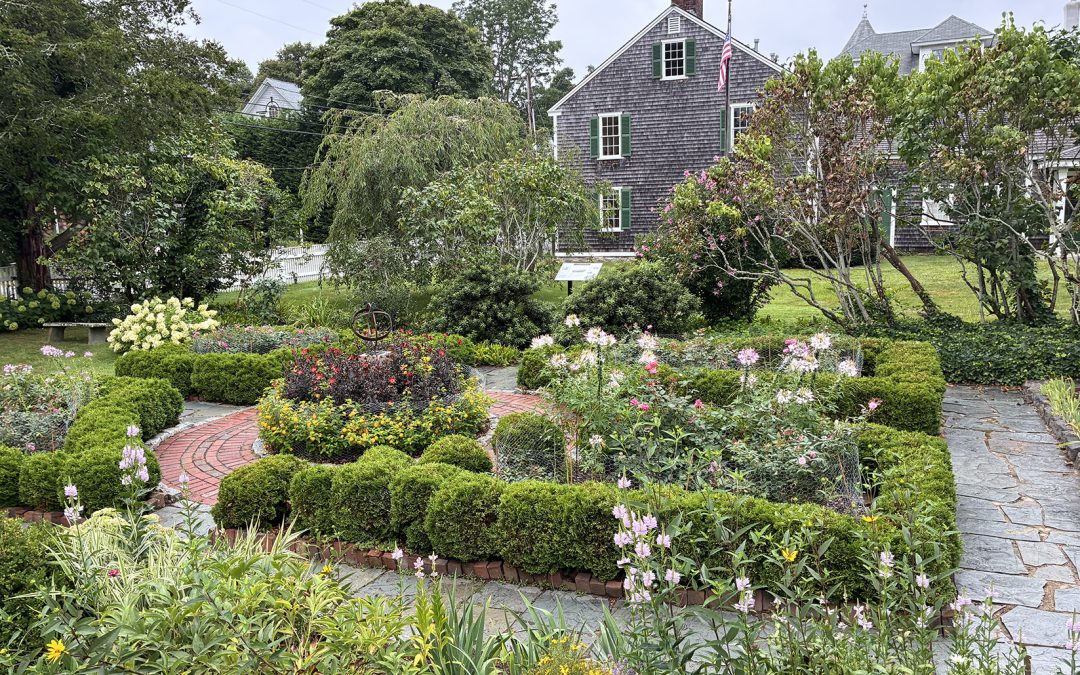
Colonial Garden at Museums on the Green Colonial Garden next to the Wicks House at Museums on the Green, maintained by Falmouth Garden Club
Ninety-five years ago, Caroline E. Welch of King Street hosted a gathering at her home to plan a new organization, the Falmouth Garden Club. It was March, and the 11 women there were focused on the upcoming growing season. Dues were $1, and in order to join, the members had to “love growing gardens and flowers.” Mrs. Howard Swift of Palmer Avenue was elected president.
Their first action that year was to plant a five-foot Douglas fir in honor of the George Washington bicentennial. By the following year, membership had increased to 75, and the club received a blue ribbon for its entry in the Cape Cod Horticulture Show. The club joined the Garden Club Federation of Massachusetts in 1934, an ongoing affiliation.
Through the following decades, membership increased and the club became involved in a wide range of community activities. It began restoring the garden at the Falmouth History Society, a project that has continued through the years.
In 1938, The Falmouth Enterprise reported that at the club’s annual garden show at First Congregational Church of Falmouth, “1,000 plants of the Korean chrysanthemum will be delivered to Falmouth so that Falmouth can be made an autumn center for tourists by town-wide planting of these showy flowers.” Half were to be planted on public grounds and the rest distributed to club members for private gardens.
In the early 1940s, the club was involved in the war effort for food conservation. Victory gardens on the Fay estate in Woods Hole were flourishing and hundreds of vegetables were canned for use the following winter, the Enterprise reported. “The gardens are a part of the Falmouth Garden Club war project. Mrs. Dean F. Bumpus is chairman of the Victory Gardens. Gardens are laid out in plots of 1,000 square feet each. Family canning parties are becoming a fad in Woods Hole with husbands and wives cooperating in the kitchen. Mr. and Mrs. Allyn C. Vine canned 150 ears of corn and 20 cans of tomatoes in one evening.”
In 1943, the Falmouth Garden Club honored Michael Walsh, gardener for the Joseph Story Fay family of Woods Hole, who developed the famous Rambler rose in the late 1800s. A memorial boulder, donated by the Fay family to commemorate him, was placed by the club on land across from Little Harbor, where club members planted many species of his Rambler rose. “Near this place lived Michael H. Walsh who made the Rambler Rose world famous. Maintained by the Falmouth Garden Club,” a plaque reads.
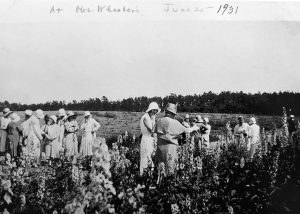
At Mrs. Whealer’s, June 25, 1931
Also, during the 1940s, the Juniors’ Gardeners Club, consisting of fourth and fifth graders from the Village School (now Mullen-Hall), began meeting weekly with the Garden Club. The club had already established a scholarship for a Falmouth child to attend the Woods Hole Children’s School of Science.
In 1956, the Garden Club received a letter from then-senator John F. Kennedy, noting their involvement in land conservation. “I know that you and the members of your club will be pleased to know that I, along with Senator Saltonstall, intend to introduce a bill in the Senate for the purpose of having the land bordering the Cape Cod Canal established as a National Park,” Kennedy wrote. As president, he signed legislation to authorize the establishment of the Cape Cod National Seashore.
Carrying on their civic conservation involvement, in 1957 FGC members met at the home of Mrs. Franklin King of Quissett, urging that the Garden Club back every effort to save the trees on East Main Street threatened by a proposal to widen the street. Letters were sent to the tree warden, highway engineer and selectmen.
During this decade, the club also began arranging garden tours of private residences and giving awards at Christmas for decorated homes.
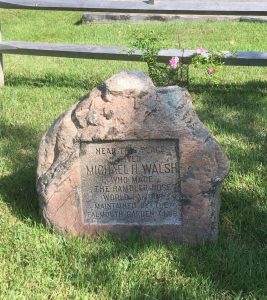
Photo courtesy of Woods Hole Historical Museum
In 1943, Falmouth Garden Club honored Michael Walsh, gardener for the Joseph Story Fay family of Woods Hole who developed the famous Rambler rose in the late 1800s, by placing a memorial boulder to commemorate him on land that is now part of the Woods Hole Historical Museum campus.
In the 1960s, the Garden Club continued its community and education commitments by convincing the town to create the Falmouth Council for Civic Beautification. The new group established scholarships for local high school students, hosted an intergenerational junior/senior gardener program, and began an outdoor classroom for fifth and sixth graders at the Falmouth Intermediate School (now Morse Pond).
By the 1970s, the club had enhanced the outdoor student education program by building a dock at Morse Pond. And as a bicentennial gift to the town, the club planted a Memorial Garden, located at Falmouth Historical Society/Museums on the Green.
During the 1980s, fundraising activities included the organization’s tradition of quilt-making to support scholarships and other projects, and participation in the Falmouth Harvest Festival. The club celebrated its 50th anniversary at the Cape Codder Hotel in Hyannis with a flower show.
The Garden Club published a cookbook in the 1990s and helped landscape a Habitat for Humanity house. Unfortunately, Hurricane Bob in 1991 destroyed the Memorial Garden and the club had to give up its maintenance.
The following decade, however, with help from a local corrections facility, the club was able to begin cleaning up the Memorial Garden and restoring it, and it was later selected as one of the Historic Gardens of Massachusetts. Members also landscaped the grounds near the cupola in front of Mullen-Hall School, which had been saved and repositioned when the Hall School was torn down in 2003.
Highlights of the following decade included receiving a Garden Club Federation of Massachusetts Historic Preservation certificate for its tradition of decorating Museums on the Green’s Wicks House for the holidays. And in 2021, the club commemorated its 90th anniversary with a donation to the town’s apple orchard.
With a membership of about 125 people, and now one of the oldest federated garden clubs in Massachusetts, the Falmouth Garden Club’s current activities continue those begun in its early decades: community beautification, conservation and ecology, and education of members and the community. Annual scholarships are awarded to local students pursuing advanced education in related disciplines, and monthly meetings are open to the public on the first Monday of each month.
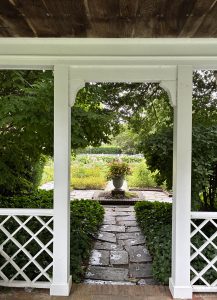
Photo courtesy Deborah Scanlon
Colonial Garden at Falmouth Museums on the Green is developed and maintained by the Falmouth Garden Club.
The club’s civic beautification projects involve maintaining several gardens. On the campus of Museums on the Green, the Falmouth Garden Club annually provides 600 hours of work on these gardens: the Blue Star Byway, a raised garden near the parking lot to honor men and women who serve or have served in the armed services; the Colonial Garden next to the Wicks House; and the nearby Herb Garden and Memorial Park. The Cupola Garden nearby on Katharine Lee Bates Road in front of Mullen-Hall School is also maintained.
The club also plants window boxes at the Falmouth Bus Depot on Depot Avenue, which are planted in early June and maintained throughout the summer. At the Walsh Rose Garden, which is now part of the campus of the Woods Hole Historical Museum, a member of the Falmouth Garden Club works in conjunction with the museum to maintain the garden.
Robin Ketchum, a member of the Falmouth Garden Club for 25 years, grew up in Falmouth, moved away, then came back and joined the Garden Club. She said she loves working in the gardens and participating in the house tours, and “whenever anyone calls and asks me to help out, I never say no. It’s a great group. And it is thriving.”