
By Barbara Clark and Contributors
putter verb
put•ter
puttered; puttering; putters
intransitive verb
1 : to move or act aimlessly or idly
2 : to work at random: TINKER
Puttering defined: To do small tasks as found around the house (Free Dictionary). To spend time in a relaxed way doing small jobs. (Merriam Webster)
Does everyone putter? Of course we do. Puttering is an occupation that often includes the satisfaction of working on small projects without the pressure to accomplish a major feat. Especially during these current times, when it often seems we’re just hunkered down waiting for the next bad thing to happen, these quieter, more personal activities offer a breather from the stress and divisiveness of the “outer” world.
What about some of the busy folks whose faces we often recognize in and around our local community? What about their “puttering side”—do they take time to listen to their own inner tunes?
 Susan Bauer
Puttering
In Kenneth Grahame’s “The Wind in the Willows,” Water Rat says to Mole, “Believe me, my young friend, there is nothing—absolutely nothing—half so much worth doing as simply messing about in boats.“ To me, this is the essence of puttering. It’s the process, not the destination, that matters. It’s the loving attention to small daily tasks that quiets the mind and lets our gratitude for being alive bubble up.
I putter by rearranging my woodpile. Every fall, I stack logs with care, cribbing the ends, interspersing kindling with large logs, and every winter, I rearrange the whole thing. There is something so satisfying about fitting logs together—figuring out how to keep the rows straight, handling the different weights of oak, ash and maple, and creating a beautiful pattern in the process. And as I fuss over the pile, I can’t help noticing that songbirds have left their tracks on logs dusted with snow and that a mouse family has built a veritable Taj Mahal out of moss and shredded cardboard. I rearrange the last row. We are all together in this thing called life.
Susan Bauer of Falmouth is a retired psychologist, writer and founder of Old Ladies Against Underwater Garbage, an over-65 group of women who in summer swim to remove quantities of trash from Cape Cod ponds. Her new book, “Swimming With Turtles: How Wonder Reconnects Us to the Natural World,” is due this fall.
 C.L. Fornari
Puttering Around At Poison Ivy Acres
To me, “puttering around” means doing something for the pleasure of it, not because it has to get done. So, cooking or baking something new or unusual would be my idea of puttering, while making dinner is not. Potting up a mixed container of herbs or annual flowers is a form of puttering, while weeding or planting new perennials or shrubs is not.
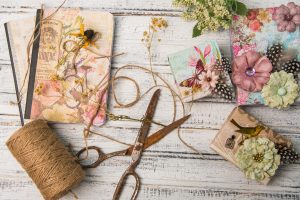
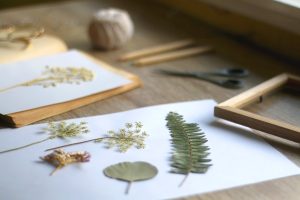
Most of my puttering involves things that are visual and creative. I love making a new display on my mantle that combines objects from closets or other rooms around the house. I enjoy putting together combinations of potted plants and natural objects on the bench outside of my kitchen door, or making a rustic trellis or obelisk out of sticks. Or I might get interested in drying or pressing flowers, or using leaves to create a design that gets photographed.
Indoors, my puttering is often in Photoshop, where I take parts of photos that I’ve taken and combine them into photo-generated collages. Some of these compositions are used as virtual backgrounds for Zoom presentations, as slides for talks, posts on social media, or just for my own pleasure.
I putter around with words as well, sometimes combining them into poems or blog posts, and other times jotting down what may be the start of a new book.
[For me], puttering is all about taking assorted parts and combining them into something new. Whether it’s in the kitchen, the garden, at home or on the computer, puttering is all about having an idea about combining flavors, textures, shapes, colors, words or objects and combining them in new and interesting ways.
Cape Cod’s well-known “Garden Lady” is a writer, speaker, radio host and garden expert who calls herself a “plant geek.” She is the author of numerous books on the subject of gardening.
 Meg Borden
I spend much of my spare time plotting small escapes from my house to avoid the organizational tasks waiting inside. My preferred destinations are art exhibits, museums or garden stores—anywhere that feels like a gentle detour from responsibility. I also love to walk, whether alone, with friends or on organized outings with Cape Cod Nordic Walking or The 300 Committee. When I return from these afternoon adventures, there are online articles to read, vacations to plan and a steady stack of books and streaming shows competing for my attention.
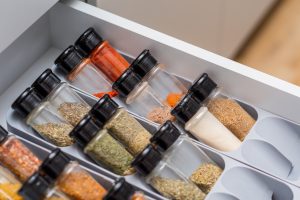
Ironically, I already own everything I need to organize my house. There are empty plastic containers for photos, baskets for toiletries and jars for pantry staples. The only space that has achieved true order is my spice drawer, thanks to its stadium-style layout that practically begs to be alphabetized. People might suggest books on decluttering, but I have no interest in reading them. My problem isn’t a lack of instruction—it’s a lack of motivation.
One occupational perk (connected with the library work) is that I can bring home a new assortment of books every day, and I read across almost every genre. I enjoy cooking when I have people to cook for, and I adore reading cookbooks even when I never make a single recipe. Sometimes I juggle several books at once, especially when one requires more concentration. I’m perfectly content reading or getting absorbed in Netflix, and the pantry will always be there tomorrow, waiting patiently for its turn.
Meg Borden is the assistant library director at the Falmouth Public Library. She has been actively involved in the Falmouth community, serving on the boards of several community groups. She served as a Falmouth Town Meeting member for nearly 30 years.
 Paula Peters
Puttering
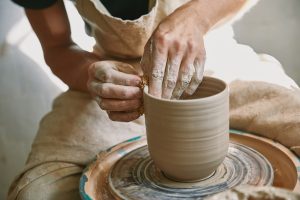
Creating is cathartic; I just wish I had more time for it. Working and raising 13-year-old twins leaves little time for things that give me personal joy like doing beadwork, sewing and now, making hand-coiled pottery. I must schedule time when I know the house will be quiet and I won’t be disturbed. Then just introducing my hands to mounds of wet earth that have thousands of years of experience in other forms, to make something new of it is so relaxing.
I have the great honor of being an apprentice under my cousin Ramona “Nosapocket” Peters, a master of Indigenous pottery inspired by historic techniques and styles of our Wampanoag ancestors. The first thing she taught me was to respect the clay as a relative, to let it live and breathe itself to life in my capable hands. In that way, I never know what she will be until she is fully realized. I am inspired by the circumstances I may be in, but I always want to create something positive and beautiful. She tells me when she is done.
Paula Peters is a journalist, activist and public educator of Native history, and a member of the Mashpee Wampanoag Tribe. She is the owner of SmokeSygnals Communications Company.
 Laura Reckford
To Be Filed Under Nostalgia And Old Cape Cod
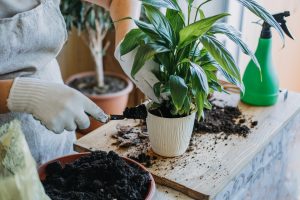
When I have free time to putter around the house, I channel my late mother, who made a project out of cleaning out all her ephemera collected over a lifetime (old letters, photos, et cetera), selecting the important things, discarding the rest and compiling the meaningful things into albums/scrapbooks that she then gave to her children.
I bought a bunch of three-ring binders and plastic sleeves and have been doing the same.
When I get stuck on something (should I keep or toss?), I might call up an old friend who has a link to the item and get their advice. “Do I need to keep the typed letter I received from the owner of Wellfleet By The Sea when we first rented a cottage there in the summer of 1986?” His answer: “No.” But I keep it anyway.
Laura Reckford is executive director of the Falmouth Art Center. She is also cofounder and editor of the digital magazine Cape Cod Wave.
 Mary Richmond
On Puttering
My grandmother was always cleaning, cooking, folding or ironing something. Some days she’d put on her apron and sort of wander around with no specific task, and this mystified us as children. “What are you doing?” we would ask. “Just puttering,” she would say. She’d pick up something and polish it with a corner of her apron or stop to watch the birds out the window.
Now that I’m a grandmother myself, I find myself puttering about as well. Repot a plant here, straighten out a picture hanging on the wall there. No plan, no rules, just doing things as they come up, or not.
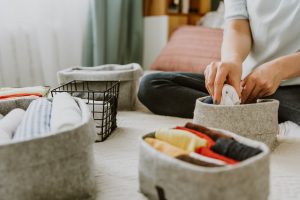
Much of my puttering has to do with loosely organizing things. As an artist, I have piles of paper, more tubes of paint than I’ll ever use up, and old sketchbooks and paintings to look through and decide whether to keep or dispose. While amassing piles, I may stop to clean out the coffeemaker or go weed the garden for a few minutes. I may send a card, take a quick walk, bake some cookies, all on a whim. For me, puttering is about doing what I feel like doing in the moment, no pressure.
Mary Richmond is an artist, writer, naturalist and educator. She grew up in Hyannis, raised her family here, and can be found creating art, drawing and painting in Cape Cod’s natural habitats.