
By DEBORAH G. SCANLON
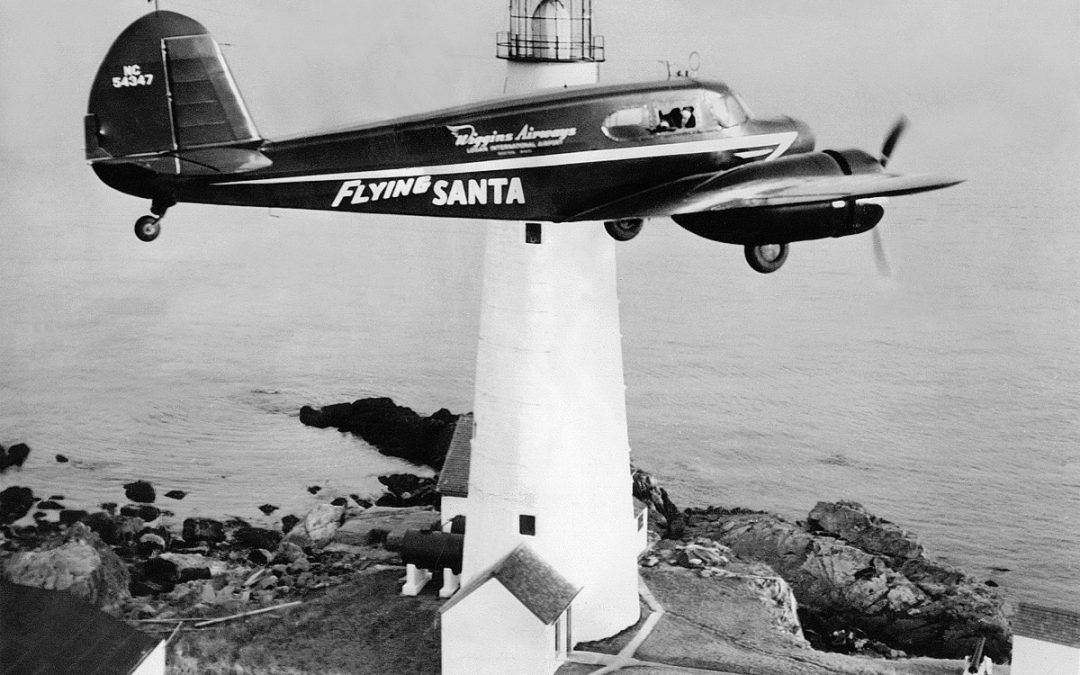
On Christmas Day 1929 William Wincapaw, a pilot based in Rockland, Maine, air-dropped gifts from his plane to families living in lighthouses along the Maine coast. Having flown many times in difficult conditions, Wincapaw was thankful for the lighthouse beacons that helped him navigate and the keepers who maintained them.
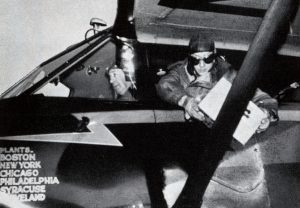
Courtesy of the Wincapaw family
The first Flying Santa, Capt. William Wincapaw, and his son Bill Jr. demonstrate their technique for dropping packages from their plane in 1937.
Their gratitude for his kindness was immediate, and the Flying Santa tradition had begun. The packages he provided were filled with simple items such as newspapers, coffee, tea, candy, pens and pencils, and they were much appreciated by families in remote outposts. In the years that followed Wincapaw added Coast Guard stations along the Maine coast, then expanded into Massachusetts, Rhode Island and Connecticut.
Wincapaw’s son, Bill Jr., later joined him on the lighthouse trips and became a pilot at the age of 16. Their Christmas flights took them to 91 lighthouses and Coast Guard stations. Assistance with their gifts was provided by commercial sponsors.
In 1933 the Wincapaw family moved to Winthrop, Massachusetts. Bill Jr. was a student at Winthrop High School, and Edward Rowe Snow was his teacher. Snow, a Winthrop native, had gone to sea for nine years before attending Harvard University. He wrote many books on maritime history, including “Famous New England Lighthouses” and “Storms and Shipwrecks of New England.” The New York Times called him “the best chronicler of the days of sails alive today.”
When the Wincapaws needed help with their Flying Santa missions, Snow became involved. In 1936 they divided the routes, and Snow, with his student Bill Jr. as pilot, covered southern New England. The senior Wincapaw flew alone, taking care of the northern route.
By the late 1930s the Wincapaws’ careers as pilots made it difficult for them to regularly continue their involvement in the project, and Snow became the official Flying Santa.
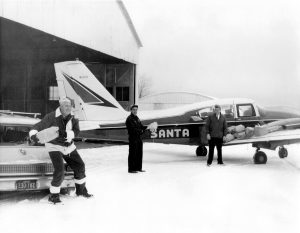
Courtesy of Dolly Snow
Bicknell Flying Santa Edward Rowe Snow loads the plane with Len Carroll and pilot Al Aucoin at Norwood Airport in 1962.
During World War II, flights were less frequent due to security and Snow’s and the Wincapaws’ wartime service. By Christmas 1945, Flying Santa Edward Rowe Snow was back on the job. He was not a pilot, so he covered the costs of hiring pilots and charter planes. He rarely used a helicopter, which was more expensive, but for one situation he felt it was essential. The story is shared by Brian Tague, president of the Friends of Flying Santa, on their website.
“During [Snow’s] delivery drop to the keeper’s family at Cuttyhunk Island off the coast of Massachusetts, a package containing a doll for 5-year-old Seamond Ponsart was smashed on a rock. The little girl was heartbroken at the sight of the damaged doll.”
Snow heard about the situation and wanted to make the child happy, so the next Christmas he chartered a helicopter.
“On December 12, 1946, Mr. Snow set off from the Boston Airport in one of the first commercial helicopters, to make the flight to the southern New England lighthouses. Roy Beer, a pioneer in helicopter flight, was at the controls. Seamond’s father was now the keeper at West Chop Light on Martha’s Vineyard. Arrangements had been made for the Ponsart family to meet Santa and his helicopter when it landed at the nearby Gay Head lifesaving station. Upon landing, Mr. Snow was able to safely and securely place a doll into the welcoming arms of little Seamond.”

Photo by Brian Tague
The Flying Santa helicopter approaches Nobska Lighthouse, 2015.
That same year, Captain Wincapaw and his son returned to assist Snow with his visits. They were able to reach 115 lighthouses and Coast Guard stations from Cohasset to the Canadian border.
In 1947 the senior Wincapaw died, suffering a heart attack while flying out of Rockland, Maine. In his honor, Snow expanded the program that year and visited 176 lighthouses and Coast Guard stations from Canada to Florida.
Snow continued as Flying Santa for more than 40 years, often accompanied by his wife, Anna-Myrle, and their young daughter, Dolly.
In a 2020 interview with the US Lighthouse Society, Dolly (Snow) Bicknell remembered the ping pong table in the basement of their family home covered with packages containing a range of gifts from candy, pens, cigars and razors (donated by Gillette) to her father’s latest book and a self-addressed card for the lightkeepers to return to acknowledge that they had received their presents.
The packages would be wrapped in newspaper, padded for protection and buoyancy, covered in brown wrapping paper, then wrapped in twine. She said she learned to tie a bowline knot in the twine that would facilitate tossing the packages out of the plane window.

Photo by Brian Tague
Flying Santa prepares to land at Nobska Lighthouse in 2015.
In 1953 Snow expanded his route, flying in an amphibious plane provided and piloted by the US Coast Guard to deliver presents to families in lighthouses from the East Coast to West Coast. He also visited facilities in the Great Lakes, Bermuda and the Miquelon Islands, as well as Sable Island, 100 miles east of Nova Scotia. “After arriving by seaplane” on Sable Island, “he jumped aboard a wagon drawn by several of the island’s semi-wild ponies and delivered his gifts to the three children and 23 adults residing on the island,” according to the Friends of Flying Santa.
In 1977, FAA regulations and insurance coverage increases prompted Snow to switch from fixed-wing planes to helicopters. He would still drop packages from the air, but most of the time he would land at the lighthouses and give presents to the children.
Due to poor health, Snow’s last Flying Santa flights were in 1980. He died in 1982.
The Flying Santa project was then taken over by the Hull Lifesaving Museum, and in 1997 the nonprofit Friends of Flying Santa assumed leadership.
Despite changes, such as automation of the lighthouses, the Flying Santa would continue to visit lighthouses.
Nobska Lighthouse served as housing for the commander of Coast Guard Group Woods Hole. Retired Coast Guard Captain Russell Webster said, “Every year, during my tenure as Group Commander (from Duxbury around to the CT/RI border and out 200 miles) from July 1998 to July 2001, a true honor was hosting the Flying Santa program. Honoring my service’s heritage as ‘keepers’ of Nobska was a delight.”

Photo by Brian Tague
Flying Santa Thomas Guthlein arrives at Nobska Lighthouse in 2015.
He added that “seeing the pure joy on my children, Andrew and Noelle, and all the other Coasties’ children’s faces as they were greeted and received gifts from Santa and his elves was a highlight of my time in Woods Hole.”
Friends of Flying Santa president Brian Tague said that currently, “Each year, we undertake four helicopter flights to deliver gifts to 1,200 children from 100 Coast Guard units at more than 30 locations in Maine, New Hampshire, Vermont, Massachusetts, Rhode Island, Connecticut and Long Island.”
“We stopped landing at Nobska Point Light 10 years ago because there were too many people to fit into the keeper’s house. We now land at the Coast Guard pier at Little Harbor,” Tague said.
One of Snow’s most frequent pilots over his 40 years as Flying Santa was Albert Aucoin, recognized in a memorial plaque at Nobska Lighthouse. The Friends of Flying Santa website has a list of all the pilots since 1929, as well as the names and photos of the airplanes and helicopters used.
Much of the background information and photos for this article were provided by the Friends of Flying Santa.