
By CHRISTINE LYNCH
“Looking up at the night sky is a treat. Constellations, the Milky Way, galaxies and even nebulae are visible with the unaided eye. But viewing the cosmos through a telescope delivers bold, luminous details.”
Looking up at the night sky is a treat. Constellations, the Milky Way, galaxies and even nebulae are visible with the unaided eye. But viewing the cosmos through a telescope delivers bold, luminous details. Happily, backyard astronomers don’t need clunky apparatus to see celestial targets and don’t have to pay big bucks, either. There is an endless variety of telescopes available to suit any purpose, budget and ability.
As members of the Cape Cod Astronomical Society (CCAS), my colleagues and I often get asked for recommendations about what scopes to buy. At holiday time, folks might consider getting a scope for a holiday gift. This is a truly fine and generous present because it is fun to use, can be used for many different projects and will last for a long time.
Up until recently, telescopes—even the relatively unsophisticated ones—tended to have a steep learning curve from opening the box to seeing clear images. Most scopes need assembly, but then once you have the tube set onto the tripod, it still might not fix on a target or, if it finds one, the image is too blurry. There is the physical alignment of components, the mirrors, tube and mounts, and there is optical alignment where the image must be exactly focused.
There are two general types of scopes: reflectors and refractors. Reflectors tend to be a bit more complex, with mirrors that must be properly aligned (known by the term collimated). They can have a bigger aperture and are lighter. Refractors utilize lenses and are collimated by the manufacturer.
Once a telescope is properly sorted, there are endless possibilities of what to view. Scopes with a larger aperture are better for small objects such as the planets like Venus; Mars; Jupiter and Saturn; and deep space phenomena, such as nebulae and galaxies. While smaller apertures excel at searching larger areas for open clusters or the moon.
Smart Telescopes

Alan Collette
The Great Orion Nebula taken by CCAS member using a SeeStar S50.
Luckily for backyard astronomers, there is a new generation of smart telescopes that are cheaper and easier to use. These are computer-driven, allowing the user to automatically find and track an object. It interfaces with a smart device—phone or iPad–through an app that captures, stores and stacks images until they are ideally enhanced. Stacking saves images and adds them on top of others for a specified length of time, producing the most defined picture.
A few bonuses are that many do not require assembly. I have witnessed more than one person open a shipping box of a SeeStar and have it fully operational, producing images within 15 minutes. Also, the internal processor allows the system to “see” through less-than-ideal conditions. This proves invaluable in a humid area, such as the Cape. Many scopes, such as the inexpensive SeeStars, even include a solar filter for safe daytime studies of the sun.
Smart scopes have embedded software that retains the coordinates for tens of thousands of objects, so when it is ready to go, it quickly finds what you choose, giving you hours of hassle-free night observations. Reasonably priced, these can make a special family gift to open this holiday season. And, you can use the new treasure right away because the winter skies are some of the year’s clearest. If you are lucky enough to live in a dark area without obstructions, you can set up right outside your place. Otherwise, head to a nearby beach or open field.
One note, though: there is a big difference between what you’re seeing when you see an object through a telescope and seeing a digitally processed image of it. There is no comparison because the latter gathers hundreds of thousands of times more light than our eyes can to create the image. Once processed, the final rendering is larger, clearer and well-defined. It is a triumph for neo backyard astronomers who now have astrophotographic bragging rights.
Some Brands and Models
Here is a brief list of telescopes with varying capabilities and prices (all costs are estimates):
• Dwarf Mini, $399
• Dwarf 3 Smart Telescope, $549
• SeeStar 330, $339
• SeeStar 550, $549
• Celestron Origin Mark II Smart Telescope, $4,300
• Unistellar Odyssey Smart Telescope, $2,300
• Vaonis Hestia, $300
• Vaonis Vespera II, $2,500
Those scopes offer different types of experiences. Some allow for visually viewing stacked images through the scope; others do not. Instead, they send the image directly to your synchronized device. Phones do get the image, but the impact is much nicer on a larger screen. At CCAS Star Parties, members usually display the images on iPads. Although one inventive member projects his SeeStar images onto a large screen monitor that sits in his pick-up truck bed. Crowds gather around to see what he’s showing.
Another accomplished member did some research back when smart scopes were a novelty. He read reviews in Sky & Telescope magazine that compared the Vaonis models with the Unistellar, which the article favored. So, he followed that advice.
Based in France, Unistellar has come up with advanced technology and optics, and includes a viewing port on the tube. Users can watch as the image in the frame is enhanced by precision stacking on the scope, along with what is on a device screen. This makes the viewing “feel” more real.
When he brought his new scope to one of our Star Parties, the images astounded us. Now, CCAS has an assortment of smart scopes in use at our events.
Since his purchase a few years back, that member mentioned that there’s “been an explosion of smart scope products.” They are being developed at a revolutionary rate. New models, already in the works, have better optics, larger apertures and upgraded imaging sensors. You can choose to wait or buy one now, then replace it when significantly improved models are available. It’s best to do your own research to consider what model is best for you.
Using Your Scope

Marinna Martini
Comet Lemmon taken by a CCAS member using a SeeStar S50.
There are many objects of interest traveling over us at any given time. Any fraction of the moon offers a chance to see the craters. Some of the planets put on a show, too: Venus as a crescent, the rings of Saturn and the four Galilean moons of Jupiter. There is a plethora of neighboring galaxies and nebulae, which take on fantastic shapes amid a vast crop of stars. There is a parade of satellites, and the International Space Station makes regular orbits.
Also, there is an occasional ethereal comet; we had two lingering over the region this fall, and others will traverse through. And during the day, try solar viewing with the proper filter, which often is included on new scopes.
Even practiced astronomers rely on star charts and night sky guides to see what’s overhead on any given night. Check a current sky chart for specific times, because the constellations and other objects rise and set at different times throughout the year. For instance, what is visible in mid-December at 11 PM will be up at 9 PM in mid-January and at 7 PM in mid-February.
To get started with guides, you can load any one of several apps on your cellphone, including Stellarium, SkySafari and SkyView Lite. There are also many books about backyard astronomy. To try these out before purchasing, you can find a selection at CLAMS libraries in the nonfiction section.
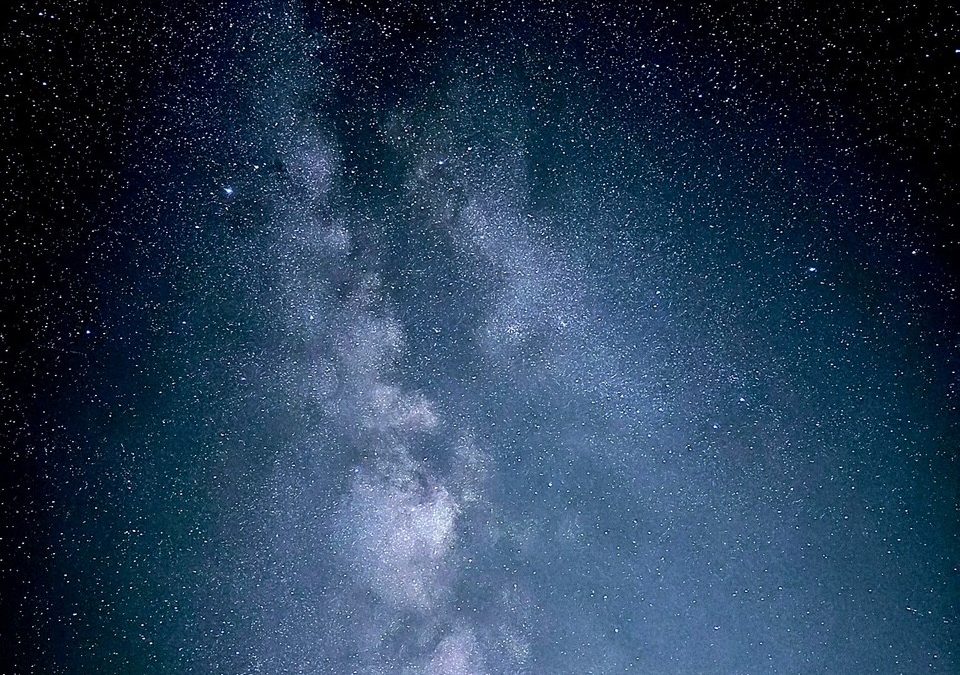
Another point: you don’t need a telescope to get good photos. One CCAS member has a particular talent and just attaches her cellphone to a tripod. She gets magnificent results, including one of the Milky Way over Coast Guard Beach. She explained, “I change the setting to night mode and move to max exposure. I then mount a phone to an adapter I bought for my tripod.” She set her phone timer to three seconds to avoid any shaking.
If astrophotography isn’t a goal and you just wish to gaze at the night show overhead, a good pair of binoculars offers an impressive show. Settle back in a reclining chair or attach them to an inexpensive tripod for hands-free viewing.
The Northeast Winter Sky
Over the Cape, the winter skies provide the best viewing and clearest skies due to lower humidity. Winter’s other advantage is that it gets dark much earlier. Wait a full hour after sunset for truly dark skies. Until the skies properly darken only the brightest objects, such as planets or bright stars, are visible. When going outside in winter, be sure to dress properly for the cold. Find warm socks, gloves, vests, et cetera, to keep you comfortable longer.
Our winter skies hold many recognizable objects. Lots have mythological or Native stories, which are fun to research and can enhance the night’s viewing.
Find the Big Dipper, whose handle points to the bright pole star Polaris; Cassiopeia (an upside-down W); the twin stars Castor and Pollux that make up Gemini; and Orion the Hunter (with the three bright stars shining on his belt). The Great Orion Nebula is found below Orion’s belt on the left. This is an expansive area where new stars are being formed. Canis Major (containing our brightest star, Sirius) and Canis Minor are Orion’s hunting dog companions. The Pleiades, or Seven Sisters, is a beautiful open cluster of stars all formed around the same time.
This list should be a good start for your backyard astronomy.
Other Resources
Sky & Telescope magazine,
www.skyandtelescope.org
Astronomy magazine,
www.astronomy.com
(click on “The Magazine”)
Cape Cod Astronomical Society,
www.capecodastronomy.org
Please join us for a meeting, Star Party or other scheduled event.